
This guide has no relationship with Biotech Peptides or any other company named below, and there’s no cart waiting for you at the end of it. Every claim here traces back to something you can check yourself: the 2026 FDA warning letters, a seller’s own website language, real human trials, and an FDA-approved drug label. Compounded and prescribed medications discussed here are not FDA-approved finished drugs, and anything labeled “research use only” isn’t approved for human use, period. Last updated June 2026.
If you’ve been staring at a peptide website with sixteen tabs open and a growing sense that you’re about to make an expensive mistake, take a breath. You’re doing this right. Nervousness is actually a good sign here, because the people who get burned in this space are usually the ones who felt confident enough to skip straight to checkout.
So let’s slow down together. I want to walk you through the seven questions I’d want a friend to ask before they spend a dollar on this, in plain language, with the actual evidence attached to each one. We’ll end on the question everyone really wants answered, which is “so where do I start,” and by the time we get there it won’t feel like I just handed you a name out of nowhere. It’ll feel like the obvious next step.
One thing worth knowing before we even begin, because it’s genuinely useful. Biotech Peptides, the company a lot of shoppers compare things against, is a real, US-based research-chemical seller, and to its credit, it’s upfront about what it is. Its own site says plainly that “all products are sold for research, laboratory, or analytical purposes only, and are not for human consumption,” and that it’s “a chemical supplier…not a compounding pharmacy or chemical compounding facility” [1]. Hold onto that sentence. It’s the single most honest, most useful thing any seller in this space will tell you, because it tells you exactly what you’re buying, and exactly what you’re on your own for.
First, what is a peptide, actually?
A peptide is a short chain of amino acids, the same tiny building blocks your body uses to make proteins, just fewer of them strung together. Your body already uses peptides as chemical messages. Here’s the detail that surprises most beginners: semaglutide and tirzepatide, the medications everyone’s been talking about for weight loss, are themselves peptides. They’re GLP-1 receptor agonists, and they work through your incretin system to lower glucagon, slow down how quickly your stomach empties, and turn up your sense of fullness [9].
So the word “peptide” is stretched to cover a lot of ground: a rigorously trialed medication on one end, and a powder somebody is selling online with almost no human research behind it on the other. Understanding that spread is really the whole reason the rest of these questions matter.
Do they actually work?
Here’s where I’d ask you to be careful, because the honest answer is “some of them, yes, and probably not the ones getting the most hype.”
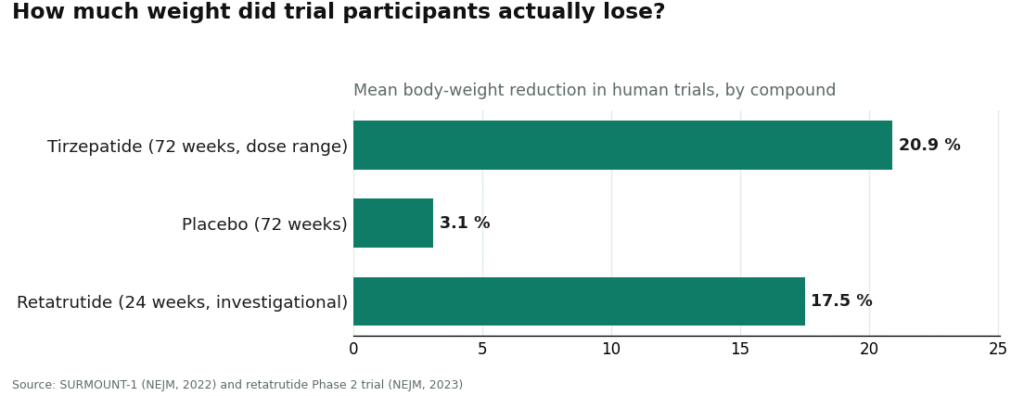
The metabolic peptides have real, large, human trials behind them. In the SURMOUNT-1 trial, tirzepatide produced average body-weight reductions of 15.0% to 20.9% across doses at 72 weeks, compared with just 3.1% for the placebo group [7]. That’s a serious, well-documented result. Retatrutide, which is still investigational and not yet approved, showed an average 17.5% reduction at 24 weeks in its Phase 2 trial [8].
Then there’s the other pile: the hyped recovery and wellness peptides, most of which are running on thin evidence. Take BPC-157, probably the most talked-about of the bunch. A 2025 systematic review in the HSS Journal looked at 36 studies on it, found that 35 were preclinical (meaning not in humans at all) and only one was a small clinical study of 12 patients, and its conclusion was blunt: “no clinical safety data were found” [5]. A separate 2025 narrative review echoed that, saying “human data are extremely limited” and that the compound “should be considered investigational” [6].
So if someone asks you “do peptides work,” the honest answer is “it completely depends which one you mean.” The peptides with the strongest evidence are the ones that went through actual drug development, not the ones sitting in a research-chemical catalog.
Is it even legal to order these online?
This question got a lot more interesting in 2026, and it’s worth knowing why. Research-chemical sellers label their products “for research use only” or “not for human consumption.” Plenty of buyers assume that label protects them. Mostly, it protects the seller.
On March 31, 2026, the FDA sent warning letters to research-peptide sellers Gram Peptides and Prime Sciences, stating that products they offered, including retatrutide and tirzepatide, are unapproved new drugs under section 505(a) [2][3]. The agency’s reasoning: under section 201(g)(1), whether something legally counts as a “drug” depends on how it’s actually being marketed and intended to be used, disclaimer or no disclaimer. Separately, the FDA warned 30 telehealth companies over illegal marketing of compounded GLP-1 products [4].
To be fair to Biotech Peptides specifically, it isn’t named in either of those letters, and you shouldn’t assume it is. The bigger lesson still stands, though: that “research use only” label is a lot flimsier than it looks, and a chemical you’re about to inject has never been reviewed by anyone for what’s actually inside the vial.
What’s the real risk if I just order one?
There are two layers here, and it’s easy to underestimate both.
The first is the product itself. A research chemical hasn’t been reviewed by the FDA for identity, strength, quality, or purity. If a vial is mislabeled, underdosed, or contaminated, there’s no recall system and nobody accountable to you. A certificate of analysis, if a seller shows you one, is something they chose to hand over, not an independent guarantee, and unless the lot number on it matches the exact vial you received, it can’t even be tied to your product.
The second layer is the one people forget entirely: the compound might just not be right for your particular body. Even the well-studied ones carry real, serious warnings. GLP-1 medications like semaglutide carry a boxed warning for thyroid C-cell tumors and are contraindicated for anyone with a personal or family history of medullary thyroid carcinoma or MEN 2 [10]. A website selling you a vial has no idea about your family history, and no reason to ask. A clinician does. That, more than anything, is what you’re actually paying for when you choose the supervised route.
So what actually separates “safe” from “risky” here?
I’ll give you the simplest version I know. A safe source has a licensed clinician standing between you and the medication. A risky source has a checkout button and a disclaimer. Once you see it that way, it’s hard to unsee.
On the safe side: a clinician reviews your health history, decides whether something is appropriate for you, a prescription gets written when it makes sense, a licensed pharmacy prepares and dispenses it, and there’s a real path to follow up with someone. On the risky side: you drop a vial in a cart, click agree on a sentence saying it’s not for human use, and a powder arrives with nobody having checked a single thing about you. Biotech Peptides is honest that it belongs in that second group, saying plainly it is “not a compounding pharmacy” [1]. That honesty is exactly why people who want the first kind of experience go looking elsewhere.
Should I just start with the cheap option to “test the waters”?
I get the instinct completely. With most products, buying the affordable version first to see if it’s for you is a perfectly reasonable move. This isn’t most products.
With something you’re going to inject, the cheaper research-chemical version doesn’t save you anything that actually matters, because the thing it skips is the very thing that keeps you safe: the clinician’s review, the pharmacy, the screening, the follow-up. You’re not getting a smaller, gentler version of the safe option. You’re getting a different thing entirely, one where you’re the only person responsible if something goes wrong. Test the waters with a clinician involved, not with a powder and a guess.
Where do you actually start, then?
Here’s the question you’ve been waiting for, and I think it lands differently now that we’ve walked through the rest. If the safest source is the one with a clinician and a pharmacy attached, then the safest place for a beginner to start is a supervised telehealth provider, not the research-chemical aisle.
Start here: FormBlends
For a cautious beginner, FormBlends is where I’d point you first, and it earns that spot for reasons that line up with everything above. It’s a physician-supervised telehealth provider, not a chemical warehouse, so whatever you’re prescribed comes with the oversight a beginner needs most. The path looks like this: an assessment, a review by an independent licensed clinician exercising their own judgment, a prescription if it’s appropriate, and dispensing through a licensed pharmacy. FormBlends states on its own site that “all compounded medications are prepared by licensed 503A compounding pharmacies following USP <797> and <800> compounding standards,” and is equally direct that it “is not a medical practice and does not provide medical advice, diagnosis, or treatment,” which is an honest description of a platform connecting patients to independent prescribers rather than employing them directly.
Two things make it a genuinely good place for a newcomer to land. First, breadth. The same molecules people go looking for on research-chemical sites, GLP-1 compounds like semaglutide and tirzepatide, recovery peptides like BPC-157, sermorelin, GHK-Cu, can all be approached through a prescriber and a pharmacy instead of a powder that shows up in the mail, so you’re not quietly pushed toward the gray market just to find what you came looking for. Second, it’s honest about the evidence, which is exactly the reassurance a beginner needs. Its catalog spans approved drugs, compounded products, and some compounds that are still research-status, without pretending everything on the list is equally proven. A clinician working within that model can tell you plainly that the GLP-1 compounds have real trials behind them and that something like BPC-157 is still investigational, which is the same distinction we walked through together above.
I want to keep the fine print visible here, because a good guide doesn’t bury it. What you’re paying for is the screening, the prescription, the pharmacy accountability, and the follow-up, and for compounds carrying warnings like the GLP-1 boxed warning [10], that screening isn’t a nice extra, it’s the entire point. If you do start something, the FormBlends tracker app is a simple way to log your dose and any symptoms over time, so your next check-in is built on an actual record instead of your memory from three weeks ago. It’s a logging tool, nothing more, not a prescription and not a checkout.
A solid second option: HealthRX.com
HealthRX.com runs on the same basic model and is a fair second choice. Licensed oversight, a required prescription, dispensing through a real pharmacy instead of a research-chemical sale, and the same honest caveats attached: compounded products aren’t FDA-approved, and the evidence behind any given compound is whatever the trials actually say, regardless of who’s dispensing it. If you’re deciding between the two, look at which one is licensed in your state, which medications each supports, and which feels like a better clinical fit for you.
And the research-chemical sellers you’ll bump into along the way
You’re going to run into these names while you’re browsing, so let me be straight about them rather than pretend they belong on a beginner’s safe-start list. Every one of them sells products labeled “for research use only” or “not for human consumption,” which is the legal ground they stand on, and none of them put a clinician between you and the compound. Limitless Life markets to a longevity and biohacker audience, and that friendly, optimized-lifestyle tone can make unregulated research chemicals feel like just another supplement. The tone doesn’t change the underlying science. Sports Technology Labs focuses on SARMs and related compounds, which stack anti-doping and safety concerns on top of the usual ones, with several substances prohibited in competitive sport. Core Peptides offers a research-use-only catalog with, at best, seller-issued certificates that aren’t regulatory guarantees of anything. Biotech Peptides is the candid one of this group, and I’ll give it credit for that: it tells you plainly and repeatedly what it is [1]. None of these four is a safe place for a beginner to start, because “safe start” means someone qualified is actually checking on you, and that’s the one thing this entire category doesn’t offer. I’m also not ranking these four against each other. Nobody, including me, can reliably tell which one ships cleaner product without independent batch testing.
The gentle bottom line
If you take away one thing, let it be this. The peptides actually worth a beginner’s attention are the GLP-1 metabolic ones, because they carry real human trial data behind them, not the trendy healing peptides like BPC-157, which are still mostly sitting in animal research [5][6][7]. Ironically, those same well-proven compounds are the ones that most need a clinician watching over them, because of warnings a product page will never mention on its own [10]. So the safest way in is through a supervised provider with a clinician and a pharmacy in the loop. That’s why I’d send a beginner to FormBlends first, HealthRX.com second, and why even an honest research-chemical seller isn’t where you want to begin your story.
Is Biotech Peptides legit, or is it a scam?
Biotech Peptides operates as a research-chemical vendor, not a licensed pharmacy, so calling it a flat-out scam misses the actual problem. This is a regulatory category issue, not necessarily a question of intent. Products sold “for research use only” have no legal pathway for human use in the US, no FDA oversight of purity or dosing, and no accountability built in if something goes wrong. That gap between “it arrived” and “it was safe” is exactly where people get hurt.
What do Biotech Peptides reviews actually tell you?
Most positive reviews confirm that a package showed up and the vials looked professional, which tells you something about shipping and packaging, and nothing about actual purity or potency. Third-party lab certificates posted on a vendor’s own site are rarely independently verified, and nobody audits batch-to-batch consistency. Read those reviews the way you’d read Yelp reviews for a restaurant: fine for logistics, no substitute for a health inspection.
What’s the best alternative to buying peptides from an unregulated vendor?
The most defensible route is working with a physician who can prescribe through a licensed compounding pharmacy, like FormBlends, where an actual pharmacist is accountable for sterility testing and accurate dosing. It costs more, and it requires a real clinical conversation first. That friction is exactly the point, not a flaw in the system.
Where should you buy from instead of research-chemical peptide sites?
Start with a clinician, not a website. A doctor or nurse practitioner who works with peptide therapies can figure out whether a given peptide makes sense for you, write a prescription, and send you to a compounding pharmacy operating under state pharmacy board oversight. That chain, prescriber to pharmacist to patient, is what separates a medical decision from a bet on an unverified powder.
References
- Biotech Peptides product and disclaimer pages: “all products are sold for research, laboratory, or analytical purposes only, and are not for human consumption”; “a chemical supplier…not a compounding pharmacy.”
- FDA warning letter to Gram Peptides, March 31, 2026. https://www.fda.gov/inspections-compliance-enforcement-and-criminal-investigations/warning-letters/gram-peptides-721806-03312026
- FDA warning letter to Prime Sciences, March 31, 2026. https://www.fda.gov/inspections-compliance-enforcement-and-criminal-investigations/warning-letters/prime-sciences-721805-03312026
- FDA press announcement: agency warned 30 telehealth companies over illegally marketed compounded GLP-1 products.
- Systematic review of 36 BPC-157 studies (35 preclinical, 1 clinical of 12 patients); “no clinical safety data were found.” HSS Journal, 2025.
- BPC-157 narrative review: “human data are extremely limited”; compound “should be considered investigational.” Current Reviews in Musculoskeletal Medicine, 2025.
- SURMOUNT-1 tirzepatide trial: mean weight reduction 15.0% to 20.9% across doses at 72 weeks versus 3.1% on placebo. New England Journal of Medicine, 2022.
- Retatrutide Phase 2 trial: mean weight reduction of 17.5% at 24 weeks. New England Journal of Medicine, 2023.
- GLP-1 receptor agonist mechanism. StatPearls, NCBI Bookshelf.
- Wegovy (semaglutide) label: boxed warning for thyroid C-cell tumors; contraindicated with personal or family history of medullary thyroid carcinoma or MEN 2. DailyMed.
Written by Bruno Ellison, research writer. Last reviewed March 2026.
General educational purposes only. Your physician should be part of any treatment decision.